The Quiet Invoice: What Missed Deadlines Really Cost You and Your Business
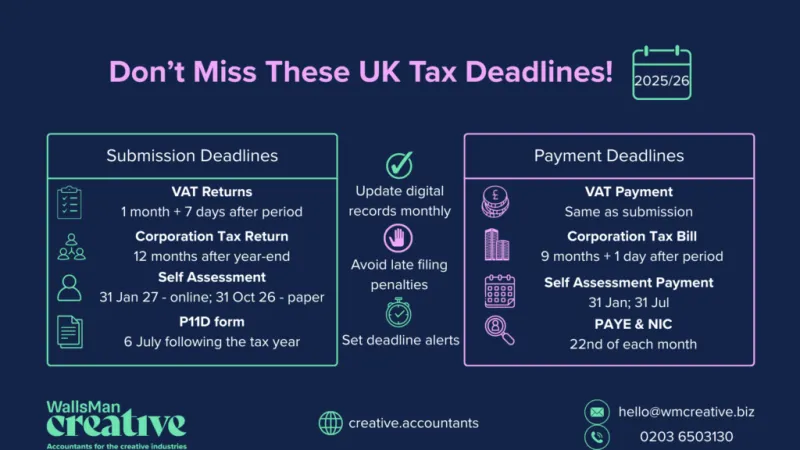
Photo: UK tax deadline calendar desk paperwork, via creative.accountants
Most small business owners do not set out to miss a tax deadline. It happens quietly: a busy trading season, a supplier invoice that needed chasing, a Self Assessment return left in the 'too difficult' pile until February. By the time the envelope arrives from HMRC, the problem is no longer just the tax — it is the accumulating cost of doing nothing.
At Pomfrey Accountants, we believe the first step to fixing anything is understanding exactly what it costs. So here it is, laid out plainly.
The Penalty Structure, Band by Band
For Self Assessment returns, HMRC's penalty regime is predictable — which is unfortunate, because it means the penalties are entirely avoidable.
| Delay in filing | Penalty |
|---|---|
| Up to 3 months late | £100 fixed penalty |
| 3 to 6 months late | £100 plus £10 per day (up to £900) |
| 6 to 12 months late | Further £300 or 5% of tax due, whichever is higher |
| Over 12 months late | Further £300 or 5% of tax due, whichever is higher |
On top of filing penalties sit late payment penalties: 5% of the outstanding tax at 30 days, another 5% at six months, and a further 5% at twelve months. A return filed eleven months late with tax unpaid can therefore attract several hundred pounds in penalties before a penny of interest is counted.
VAT and PAYE operate on a different system of points and surcharges, but the principle is identical: the longer the delay, the heavier the ledger becomes.
Interest Never Sleeps
Penalties are only half the story. HMRC charges late payment interest on unpaid tax, currently linked to the Bank of England base rate plus a margin. The rate is reviewed regularly and has been materially higher in recent years than many taxpayers expect.
Interest accrues daily from the day after the payment deadline. It is not punitive — it is simply the cost of borrowing from the Treasury, whether you meant to or not. Unlike some penalties, interest cannot be reduced for a reasonable excuse; it runs until the balance clears.
The Costs Nobody Puts on an Invoice
The visible charges are, in our experience, the smaller part of the loss.
Time tax. Every hour spent untangling receipts months after the fact is an hour not spent billing clients or winning work. Scramble-mode accounting is consistently the most expensive kind.
Professional fees at panic rates. Accountants can usually help more cheaply — and more thoroughly — when engaged early. Emergency work in the final fortnight before a deadline costs more and achieves less.
Credit and cash flow consequences. Persistent late payment to HMRC can affect your standing with lenders and, for companies, appears in publicly filed accounts. Suppliers notice patterns too.
The psychological drag. A deadline hanging over you is a genuine tax on attention. We have watched clients carry it for months; the relief of clearing it is often described as physical.
Getting Back on the Front Foot
If you are already behind, the worst response is to hide. The best is a short, ordered plan:
- Establish the full picture. List every outstanding return and payment, with dates and estimated amounts. Uncertainty, not the debt itself, is what keeps people awake.
- File even if you cannot pay. Filing penalties and payment penalties are separate. Submitting the return stops one clock ticking and often reduces the total penalty bill.
- Contact HMRC or ask us to. A Time to Pay arrangement can spread tax debts over instalments. HMRC is generally reasonable with taxpayers who come forward — far more so than with those who wait to be found.
- Check for a reasonable excuse. Serious illness, bereavement, or unexpected events can justify penalty appeals. Appeals succeed when made promptly and supported by evidence.
- Fix the system, not just the symptom. A diary of deadlines, a separate tax savings account, and a monthly bookkeeping habit will do more for you than any single rescue.
A Closing Thought
Late filing penalties are, in one sense, a voluntary tax — one levied on avoidance rather than income. The bands are published, the dates are fixed, and the route back is well worn. If your deadlines have started slipping, a conversation now will cost you far less than another brown envelope later.
Pomfrey Accountants supports small businesses and individuals across the UK with Self Assessment, bookkeeping, and tax planning. If you would rather never read a penalty table again, we would be glad to help.